
The protein expression expert team at Hangzhou Huabio has rich experience in protein expression, providing low-cost active recombinant proteins for customer-customized antigens and proteins. We have provided over 5000 high-purity recombinant proteins to scientific research institutions and pharmaceutical companies worldwide, including various receptors, cytokines, growth factors, transcription factors, hormones, enzymes, toxic proteins, viral antigens, etc., to meet the diverse needs of scientific research users.
Custom Services
Service Advantages
✅ Supernatant Active Protein: Using screened solubility tags and expression vectors, the protein expression level in the supernatant/periplasmic space reaches over 75%.
✅ High Experimental Success Rate: Optimized technology for difficult-to-express proteins, with a success rate exceeding 95%.
✅ One-stop Service: Providing full-process exclusive services from scheme design, vector construction to protein expression.
✅ Fast Delivery: Standard process takes 3-4 weeks (from gene synthesis to delivery).
Service Process
Scheme Design--Gene Synthesis--Vector Construction--Protein Expression--Protein Purification--Project Delivery.
Service Content and Description
| Service Type | Service Content | Delivery Content | Delivery Period |
|---|---|---|---|
| Prokaryotic Expression | Gene Synthesis and Vector Construction | Expression Plasmid/Glycerol Bacteria, Sequencing Report | 7-10 Working Days |
| Protein Induction Expression Test | SDS-PAGE Detection Map | 2-4 Working Days | |
| Scale-up Culture and Protein Purification | 1mg Purified Protein, SDS-PAGE Detection Map | 7-10 Working Days | |
| Eukaryotic Expression | Gene Synthesis and Vector Construction | 0.5-1mg Purified Protein, SDS-PAGE Detection Map | 15-20 Working Days |
| Small-scale Expression Test | |||
| Large-scale Transfection and Purification |
* For more service details, please call the free phone number 4008-123-175 or send an email to service@huabio.cn. We have an advanced protein expression platform and technical team, able to provide stable, efficient protein expression and purification solutions for customers. Whether for antibody preparation, functional research or structural analysis, our services meet high standards for scientific research and industrialization. For customized service plans, please feel free to contact our technical support team, we will serve you wholeheartedly.
Case Studies
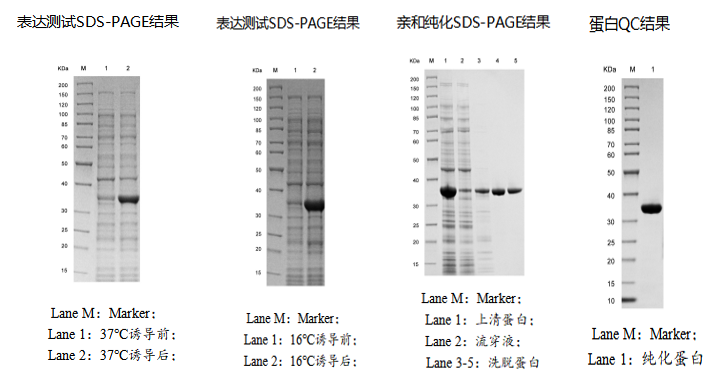
Case 1:Huabio will test different expression conditions to screen out the optimal induction expression conditions, and finally deliver high-purity protein.
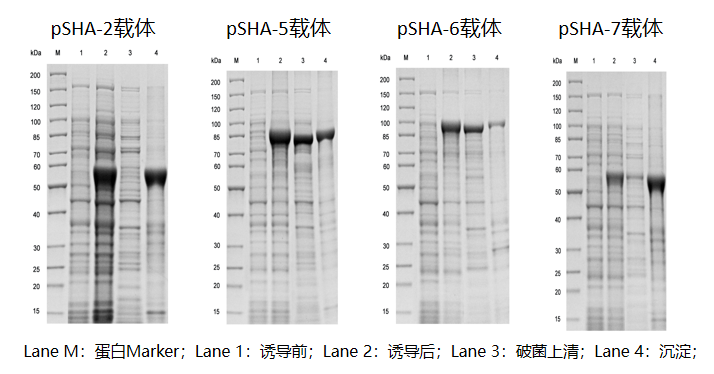
Case 2:For difficult-to-express proteins with low expression levels, we will test different vectors and solubility tags, and finally successfully express and deliver highly active proteins. Through multiple high-expression vectors optimized by Huabio screening, we have successfully achieved efficient expression of target proteins in the supernatant.
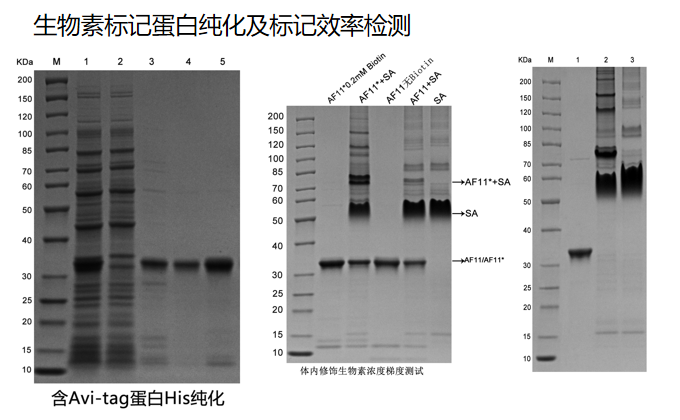
Case 3:For special needs, we provide customized services, including multi-tag combination expression, co-expression of auxiliary proteins, etc., to ensure that diverse customer requirements are met. For example, adding an Avi-tag to the sequence and performing biotin modification on the protein, finally obtaining high-purity protein with a modification efficiency greater than 95%.
Frequently Asked Questions and Answers (Q&A)
Q: How to choose between prokaryotic expression and eukaryotic expression systems?
A: The choice mainly depends on the characteristics of the target protein, application requirements and budget. Prokaryotic systems (such as E. coli) are low-cost and have a short cycle (standard process 3-4 weeks), suitable for simple, soluble proteins or inclusion body proteins that do not require complex modifications (such as glycosylation). Eukaryotic systems (such as mammalian cells, insect cells) can perform complex post-translational modifications, more closely resembling natural protein conformation and activity, suitable for membrane proteins, antibodies, hormones, etc. that require correct folding and modification, but have higher costs and longer cycles (the eukaryotic purification part takes 15-20 working days). Our expert team will recommend the optimal solution based on your protein sequence and application scenarios (such as functional research, antibody preparation).
Q: What special strategies do we have for insoluble or easily degradable proteins?
A: We have an optimized technology library for difficult-to-express proteins, with a success rate exceeding 95%. Strategies include: 1) Screening multiple solubility tags (such as SUMO, Trx, GST, MBP, etc.) and combinations to improve the proportion of soluble expression, with the protein expression level in the supernatant/periplasmic space reaching over 75%; 2) Using specially modified and optimized expression vectors and host strains to improve the protein folding environment; 3) Optimizing induction expression conditions (temperature, time, inducer concentration, etc.), as shown in Case 1; 4) For easily degradable proteins, protease-deficient strains can be selected or protease inhibitors can be added. As shown in Case 2, we have successfully solved the problem of multiple difficult-to-express proteins by screening different vector and tag combinations.
Q: What is the standard delivery cycle? What factors may cause delays?
A: The standard service cycle from gene synthesis to protein delivery is approximately 3-4 weeks for prokaryotic systems, and slightly longer for eukaryotic systems due to more complex culture and purification, especially the purification process which takes 15-20 working days. Factors that may affect the cycle include: 1) Complexity of the sequence provided by the customer: Gene synthesis and vector construction of very long or structurally complex sequences may require additional time for verification; 2) Difficulty of protein expression: If low expression or insolubility issues are encountered, optimization conditions (such as trying different tags, vectors, induction conditions) are needed, which will increase testing time; 3) Purification difficulty: Some protein purification conditions take a long time to explore; 4) Customer feedback confirmation time: Results at each stage need to be confirmed by the customer in time before proceeding to the next step. We will promptly communicate any possible schedule changes.
Q: What are the quality control standards for delivered proteins?
A: All proteins we deliver undergo strict quality control to ensure they meet scientific research needs. Core quality control includes: 1) SDS-PAGE analysis: Provide detection maps to confirm protein purity (usually >85% or higher, depending on project requirements) and correct molecular weight; 2) Concentration determination: Use accurate methods (such as BCA, Bradford, A280) to determine protein concentration; 3) Endotoxin level: For in vitro cell experiments or in vivo application requirements, low endotoxin (<1.0 EU/μg) purification options are available (please specify in advance).
Get a Quote Now
Popup
Use this popup to embed a mailing list sign up form. Alternatively use it as a simple call to action with a link to a product or a page.
Age verification
By clicking enter you are verifying that you are old enough to consume alcohol.